

Every generation has feared the tools the next one embraces. From books to the internet, history keeps telling us the same story. Now it is AI’s turn.
A post appeared on my LinkedIn feed recently. The writer, a professional content creator, announced that he had stopped using AI to write his work entirely. He argued, with evident conviction, that he simply scrolls past any content that looks AI-generated and that his clients feel the same way. He posited that audiences can smell artificial writing, that it lacks soul, and that the market will ultimately reject it.
I respect his decision. I genuinely do. There is something admirable about a craftsman who insists on doing things by hand, especially in an age that rewards speed over care. Perhaps he wants to sharpen his skills, protect his voice, or simply refuse to cede ground to a machine. Those are worthy reasons.
But his post reminded me of a debate that raged in staffrooms and educational journals decades before any of us had heard of a large language model.
The calculator wars
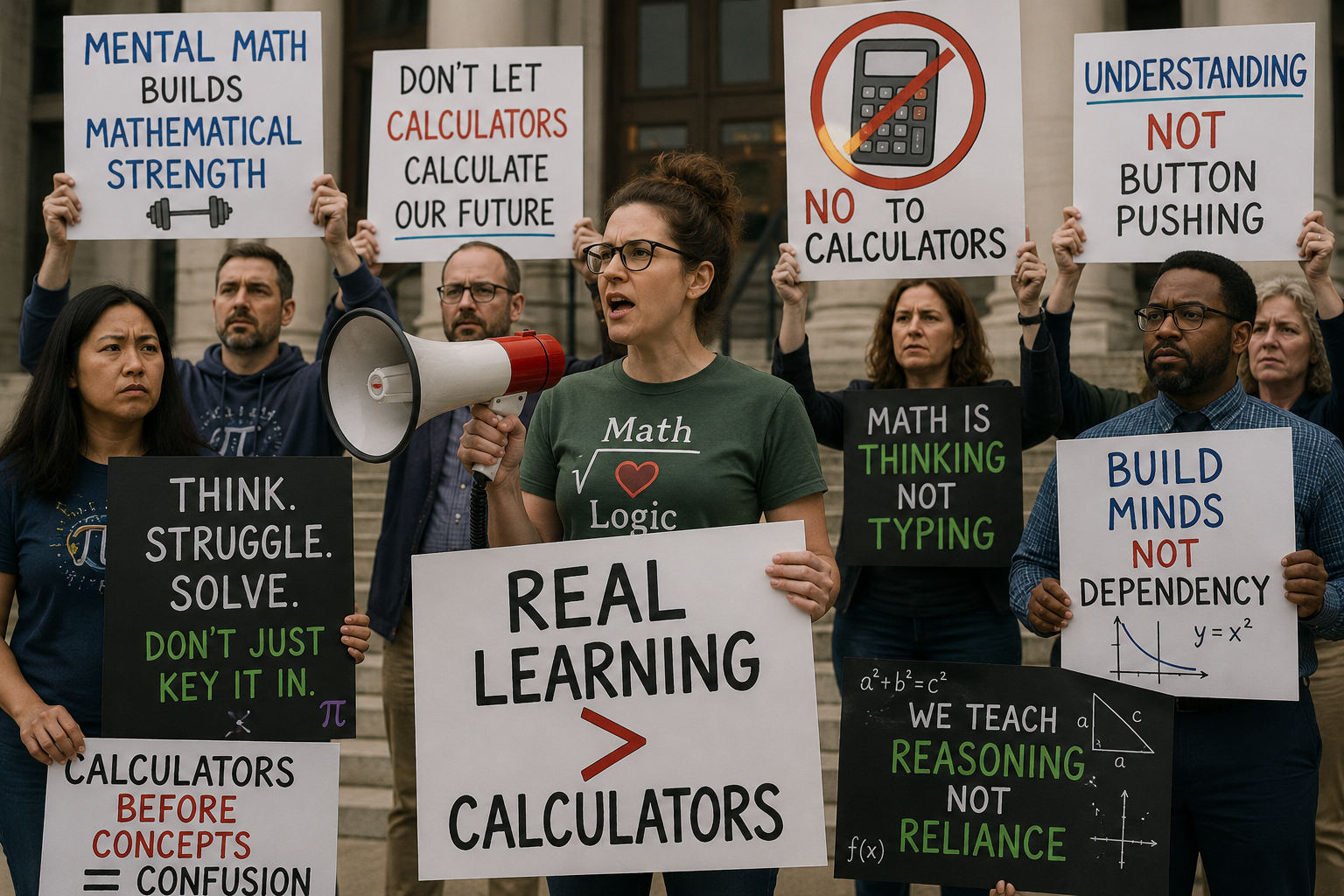
In the 1970s and 1980s, a significant number of mathematics teachers, parents, and critics raised serious concerns about the pocket calculator. Their concern was not unreasonable on its surface: if a child can simply press buttons to get the answer, why would they ever learn to think? The calculator, they warned, would produce a generation of pupils who could not perform basic arithmetic without a machine. It would hollow out the discipline. It would destroy mathematics.
“They did not destroy mathematics. They changed it and, in changing it, they freed it.”
What happened instead was rather different. Students still learned addition, subtraction, multiplication, and the logic of problem-solving. Calculators did not replace mathematical thinking; they offloaded the repetitive, mechanical parts of computation so that learners could spend more time on the parts that actually matter: conceptual understanding, analytical reasoning, and the application of mathematics to real-world problems. A student freed from laboriously computing long division by hand has more cognitive space to ask why a formula works and what the answer actually means.
The calculator did not dumb mathematics down. It raised the ceiling of what students could be expected to engage with. It changed the shape of the discipline, not its depth.
A familiar pattern
This is not a unique story. It is, in fact, one of the most reliable patterns in the history of human learning.
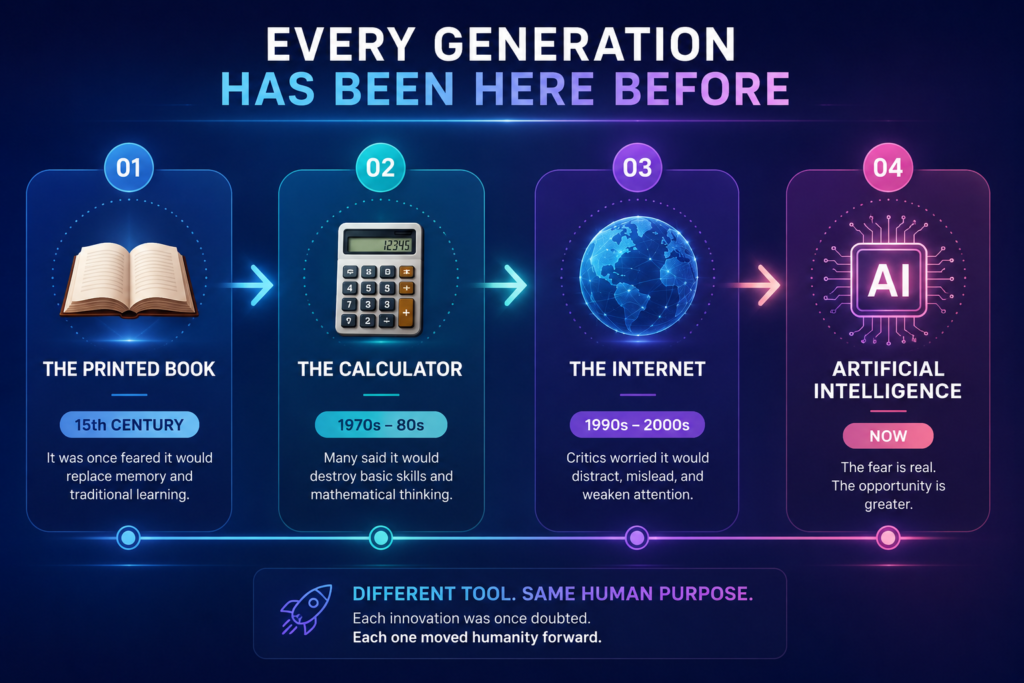
The printing press was accused of spreading dangerous ideas too freely, putting knowledge in the hands of people who lacked the wisdom to handle it. The internet was blamed for shortening attention spans, eroding deep reading, and making everyone a little less capable. Search engines, critics argued, were teaching a generation to look things up rather than to actually know anything.
Each technology did change how we learn. None of them destroyed learning. And none of the critics who warned most loudly about them were vindicated by history.
What we are already beginning to see
We do not need to speculate entirely about AI’s educational impact. The evidence is beginning to arrive.
In Nigeria, Owoeye Daniella Jesudunsin, who achieved the highest score in the 2026 Joint Admissions and Matriculation Board examinations, reportedly attributed part of her preparation to AI tools, using them to summarise her notes and organise her study material more efficiently. AI did not sit the examination for her. It helped her prepare better. Every generation has feared the tools the next one embraces. From books to the internet, history keeps telling us the same story. Now it is AI’s turn.
This is a precise and important distinction. There is a version of AI use that replaces thinking, where a student pastes an essay question into a chatbot and submits whatever comes back. That version is genuinely problematic, and educators are right to guard against it. But there is another version, arguably the more common one, where AI acts as a study companion: summarising dense material, generating practice questions, explaining difficult concepts in multiple ways until one of them clicks.
The second version does not make students lazier. Used well, it makes them more efficient, which means they can cover more ground, engage at a deeper level, and arrive at the examination hall better prepared than they might otherwise have been.
The real question about children and AI
Many people share the LinkedIn writer’s broader concerns when it comes to children specifically. The worry is that early exposure to AI tools will prevent children from developing raw cognitive abilities: the capacity to struggle productively with a problem, to sit with difficulty, to build mental muscle through effort. These are legitimate concerns and they deserve serious attention.
But the question of whether children should be exposed to AI may be the wrong frame entirely. Children growing up today will enter a world where AI is as ambient as electricity. The relevant question is not whether they encounter these tools but whether they are taught to use them wisely, to understand what AI can and cannot do, to recognise when it is helpful and when it obscures their own thinking, and to remain the ones doing the actual reasoning.
“The future of education is unlikely to be about replacing thinking with machines. It may be about empowering learners to think at a higher level.”
AI can personalise learning in ways no single teacher, however gifted, can manage with thirty pupils in a classroom. It can provide instant feedback on a first draft, adapt its explanations to a particular learner’s gaps, and allow a child in a rural community with limited resources to access the kind of patient, responsive tuition that was previously available only to the privileged few. These are not trivial benefits.
On the question of authentic voice
Returning to the LinkedIn post that started this reflection: the writer’s concern about AI-generated content is, in one sense, a version of the same anxiety. If AI writes your ideas, are they still your ideas? If the prose is machine-polished, is any authenticity lost?
These are real tensions, and creative professionals are right to think carefully about where the line falls for them. But the question of how a tool is used is always more important than the existence of the tool. A ghostwriter does not make a book inauthentic if the ideas in it are genuinely the named author’s. A calculator does not make the mathematics false. A spell-checker does not make the prose someone else’s.
The craftsman who insists on working without AI may well produce something that a machine cannot replicate: texture, idiosyncrasy, the specific weight of a human sensibility pressing against the page. That is a real and valuable thing. But the conclusion that everyone who uses AI has therefore abandoned their craft is a step too far, and history gives us little reason to trust it.
What history actually suggests
Technology rarely replaces learning. More often, it reshapes it and, in reshaping it, challenges us to think about what learning is actually for. When the calculator arrived, educators had to ask: if computation is no longer the bottleneck, what should we be teaching? The answer was a deeper engagement with mathematical reasoning. That was a better answer than the one they had before.
AI may be prompting a similar question now. If AI can summarise, draft, and research, what is the uniquely human contribution that education should be cultivating? Critical judgement. Ethical reasoning. Original synthesis. The ability to ask a better question. These are not things AI does well, and they are the things that will matter most in a world where AI handles everything else efficiently.
Every generation fears the tools that the next generation embraces. That fear is not always wrong. Tools can be misused, and the transition periods are genuinely difficult. But if the past is any guide, the answer is not to refuse the tools. It is to teach the next generation to be worthy of them.