


We are raised to believe that effort is the great equaliser. But what if the most honest thing you could do for yourself is accept that some games were never yours to win?
We are often told to give our best in everything we do. It is sound advice, and I believe it wholeheartedly. Show up fully. Commit yourself. Apply your effort without reservation, then leave the rest. When you know you gave everything you had, you can walk away without regret, regardless of the outcome.
But there is a reality that sits just beneath the surface of that advice, one that many people spend years struggling to accept: your best will not always be enough in certain areas of life. And no amount of harder work, longer hours, or sheer determination will change that.
I know that may sound discouraging. But stay with it for a moment, because I think it is one of the most liberating things a person can genuinely come to understand.
The problem is not always effort
Many people carry a quiet, exhausting belief that if they are not succeeding at something, it is because they have not tried hard enough. They double down. They push longer. They sacrifice more. And when the results still do not come, they reach the most damaging conclusion of all: that something is fundamentally wrong with them.
But the problem is not always effort. Sometimes the problem is alignment.
There is a significant difference between working hard and working in the right direction. A person can pour enormous energy into something and still fall short, not because they are inadequate, but because that particular area was never where their natural capability was designed to flourish. Effort applied in the wrong environment produces exhaustion, not excellence.
The tragedy is not that people lack ability. It is that they spend years trying to become extraordinary in areas where they were never naturally wired to flourish.”
This is not a comfortable idea, particularly in a culture that celebrates hustle, persistence, and the belief that anyone can achieve anything if they want it badly enough. That narrative has genuine merit. But it also has a shadow side, which is the guilt it quietly deposits on people who are working hard, doing their best, and still not arriving where they hoped.
The problem is not always effort
I have come to believe that human beings do not have weaknesses in the way we typically imagine. Rather, we are designed differently. Each person carries a particular configuration of gifts, instincts, and natural orientations, and those configurations are not identical. They were never meant to be.
Nature offers some of the most instructive illustrations of this principle.
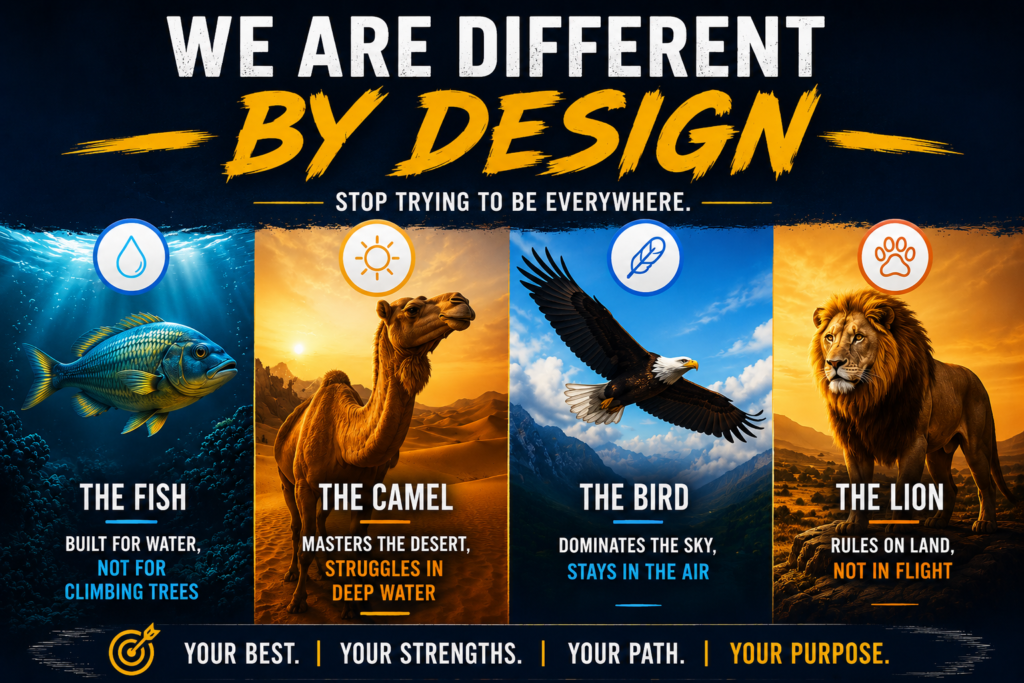
None of these creatures is inferior to the others. They are simply excellent in different environments. A fish does not fail by being unable to climb a tree. A lion is not inadequate because it cannot soar. They are each, in the right conditions, exactly what they were designed to be.
Human beings are no different, except that we have the peculiar ability to convince ourselves otherwise. We look at someone thriving in a space we struggle with, and rather than asking whether that space is right for us, we conclude that we are not right enough. We force ourselves into ill-fitting roles, chase standards set by people operating in different terrain, and then mistake the friction for personal failure.
You may not be failing. You may simply be in the wrong lane.
The problem is not always effort
I learned this through experience, not theory. For a while, I kept trying to build competence in graphic design because clients occasionally requested it. I pushed myself, invested time, and spent energy trying to force a capability that simply did not come naturally to me. I was working hard. But I was working hard at becoming someone I was not.
The turning point came when I held that effort up against something else I had been doing almost without noticing. Over six years, I have worked on more than 1,500 clients’ books. I had read manuscripts, refined ideas, shaped arguments, and helped authors find the clearest version of what they were trying to say. I had done this for hours at a stretch without feeling drained, without watching the clock, without needing to convince myself to continue.
That contrast told me something important. When work feels like swimming upstream in every moment, it is worth asking whether you are in the right river at all.
I stopped trying to become everything. I chose instead to become more of who I already was.
A conversation I still remember
During my final year at university, a colleague came by one evening to collect materials a lecturer had released. We walked out together, and somehow the conversation turned to the question of whether academic excellence was the truest measure of a person’s potential.
At some point, he said something that has stayed with me ever since.
“If academic excellence were purely a product of how much a person reads, Julius, you should not have a CGPA higher than mine or above 4.0. I read more than you. I attend night classes almost every day and do TDB during examinations. I never see you in night classes, and you do not even do TDB during exams, yet you still make good grades. It must just be grace.”
He was not wrong. I rarely attended night classes. I typically studied in the days leading up to an examination rather than throughout the semester, and I leant heavily on the summarised notes my more diligent friends had compiled. By his measure of academic effort, I had no business performing as well as I did.
But whilst he was studying for examinations at 2 or 3 in the morning, I was often still on campus too. Not in a lecture hall, but knee-deep in projects I cared about passionately. Projects that had nothing to do with my degree and everything to do with what I was quietly becoming. I was not working less. I was working in a different direction entirely, and the electricity problems off campus meant I sometimes had to return to school at 3 a.m. on days I went home early, just to continue.
It is worth noting that those side projects I had poured myself into at university have since become my business. Eight years after graduating, I have never once used my certificate in any job.
Neither of us was wrong. We were simply wired differently.
The cost of trying to win every game
One of the quieter forms of self-harm is the relentless attempt to be competent at everything. To say yes to every request. To master every skill that others seem to find valuable. To prove, continuously, that you are not limited.
This impulse is understandable. We live in a world that rewards versatility, that celebrates people who seem to do everything well. But behind that celebration is often a great deal of hidden cost: the energy spent fighting against the grain, the creative depletion that comes from spreading yourself across too many misaligned demands, and the slow erosion of confidence that happens when you keep measuring yourself against standards built for someone else.
Learning to outsource what does not come naturally is not an admission of weakness. It is an act of strategic honesty. When you stop pouring effort into areas that drain you without return, you free up something far more valuable: the capacity to go deeper in the areas where you are genuinely exceptional.
“You do not have to master everything. You do not have to say yes to every opportunity. You do not have to exhaust yourself proving that you can do it all.”
“The goal is not to become someone else. The goal is to discover where your best naturally comes alive.”
What alignment actually looks like
When a person is working in genuine alignment with their natural strengths, certain things tend to be true. Time passes differently. Effort feels less like sacrifice and more like expression. The work restores rather than depletes. Improvement comes more readily, not because they are trying harder than everyone else, but because they are operating in the environment where they were built to grow.
This is what psychologists sometimes call flow: the state of being so fully engaged in a task that self-consciousness falls away and performance lifts almost involuntarily. Flow does not visit every activity equally. It tends to cluster around the areas where a person’s natural wiring and the demands of the task are well matched.
People thrive in different environments
- Some people can spend ten hours solving mathematical problems and feel energised at the end of it.
- Others can write for ten hours and barely notice the time passing.
- Some naturally build businesses, drawn to the uncertainty and the momentum of creation.
- Some naturally lead people, reading rooms and motivating others with an ease that cannot be taught.
- Some naturally analyse, finding clarity and pattern in complexity that others find overwhelming.
- Some naturally create, translating an inner world into something others can see, hear, or feel.
None of these is superior to the others. They are simply different modes of human excellence, each valuable, each suited to different kinds of work and contribution. The question worth asking is not which of these you wish you were, but which of these you already are when no one is asking you to be anything in particular.
Stop condemning yourself for the wrong comparison
A significant amount of the self-doubt that people carry is rooted not in genuine failure but in unfair comparison. We measure ourselves against people who are succeeding in spaces we are not naturally suited for, and we treat that gap as evidence of our inadequacy.
But comparing a fish to a lion on land is not a fair assessment of the fish. It is simply the wrong environment.
If someone else is outperforming you in a particular area, it is worth sitting honestly with two questions before drawing any conclusions about your own worth. First: have you genuinely invested the time and effort that fair comparison requires? And second: is this actually your game, or are you playing on someone else’s pitch?
Both questions matter. The first guards against complacency. The second guards against the particular cruelty of spending a lifetime chasing something that was never yours to catch.
Finding the game you were built to play
Give your best in whatever you do. That counsel remains true, and it is worth holding onto. But also understand that your best will never be equally powerful across every area of life, and that this is not a flaw in you. It is a feature of how human beings are designed.
Stop condemning yourself because you do not excel where someone else does. Stop trying to force yourself into spaces that continuously drain you whilst ignoring the places where you naturally come alive. Stop treating the wrong comparison as the final verdict on your potential.
You do not need to win every game. You only need to find the game you were built to play. And when you do, the effort will feel different. The progress will feel different. Your best may finally feel like more than enough, because for the first time, it will be landing exactly where it was always meant to.